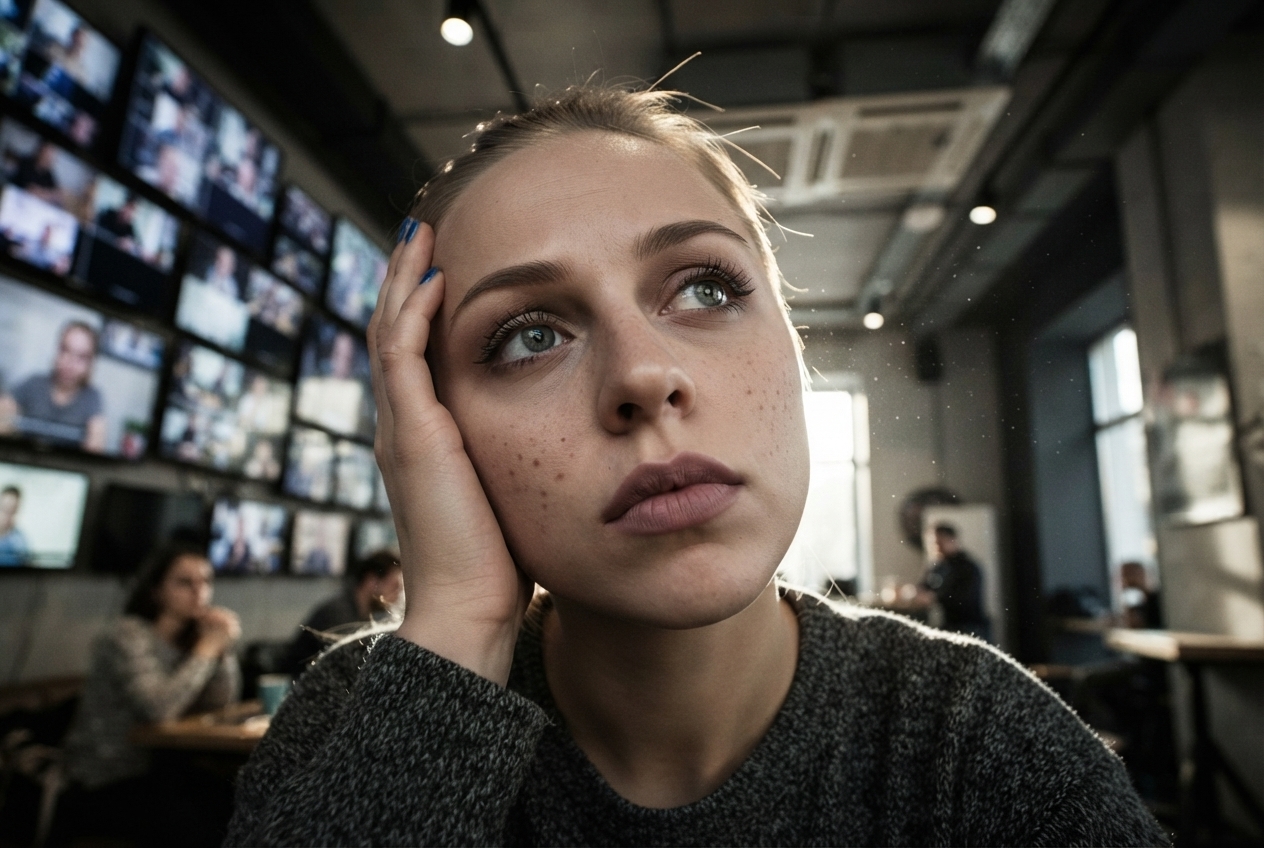

t’s half past one in the morning and I’m sat on the sofa in my Hackney flat with my legs tucked under me, black nails catching the lamp light every time I scroll. I’m still thinking about my guy, we spoke earlier, and then thought hit me. Social media. Are people going to accept him. His history. In all honesty, I should be asleep. Instead I’m doing that thing I always do when the day’s work is done and the brain won’t switch off. Thumb going up, down, refresh, refresh. Other people’s lives sliding past in neat little squares and fifteen-second clips.
Someone I used to intern with just posted a photo of herself on a balcony in Lisbon, linen dress, hair doing that effortless wavy thing mine never does after a fourteen-hour day. Caption about “finally taking the leap”. Three thousand likes in two hours. Another girl from The Coven group chat, the one who always sounds like she’s got her life together, just announced she’s been commissioned by a proper broadsheet for a series. My stomach does that familiar little drop. Not jealousy exactly. Something meaner. That quiet, persistent feeling that everyone else is moving while I’m still sat here in yesterday’s hoodie trying to remember if I ate dinner.
You know the one I mean, babes. That specific ache that kicks in when the algorithm decides tonight is the night it’s going to show you every version of the life you were supposed to be living by now. The promotion. The renovated kitchen. The couple who look like they actually like each other. The woman your age who somehow has a book deal and a baby and still finds time to do her nails. It doesn’t feel random. It feels personal. Like the app sat down, read your search history and your late-night thoughts, then said right, let’s poke that exact bruise.
I used to tell myself it was just me being a chaotic mess. Workaholic chaos goblin, permanently caffeinated, checking how many likes the other feminist journos were getting because I’m competitive as hell and I know it. But it’s not just me. It’s all of us. Scroll any comment section under a “day in my life” reel and you’ll see the same thing. Women typing “how do you do it??” with the little crying emoji, or “this is making me feel so behind”. We laugh it off in the group chat. Call it FOMO. Call it the algorithm being a dick. Then we open the app again five minutes later.
The thing that gets me is how deliberate it all feels. These platforms didn’t accidentally become comparison machines. They were built that way. Engagement is the only currency that matters and nothing keeps a thumb moving like a little hit of envy mixed with hope. Show a woman a version of herself that’s thinner, more successful, more loved, more rested, and she’ll stay. She’ll watch the next one. She’ll buy the thing in the link. She’ll come back tomorrow to see if she’s caught up yet. She never does, because the feed is infinite and the goalposts keep moving.
I notice it most on the days when I’m already running on fumes. After a late Tesco run for emergency bits, sitting in the car park with the wrap half-eaten, phone lighting up with notifications. That’s when the algorithm really goes to work. Suddenly every third post is some woman who looks like she has a cleaner, a personal trainer and a partner who does the night feeds. Meanwhile I’m trying to remember if I paid the council tax and whether my mum’s Sunday roast this weekend is going to involve the usual interrogation about when I’m “settling down”. The contrast is brutal. Real life is crumbs on the passenger seat and a vape that needs charging. The feed is filtered sunlight and “grateful for this season”.
It’s not even the big flashy stuff that does the most damage. It’s the quiet, everyday flexes. The perfectly styled desk setup when your own table is covered in notebooks and empty cans. The “just a casual Saturday” photo that took forty-five minutes and three outfit changes. The holiday that looks spontaneous but was planned six months ago and cost more than your monthly rent. You start measuring your own ordinary Tuesday against someone else’s highlight reel and of course you come up short. That’s the point. The app doesn’t want you content. Content people close the app.
I caught myself doing it last week on the train back from London. Quiet carriage, feet up on the opposite seat like usual, Kindle in my bag because I was meant to be reading something for work. Instead I was scrolling. A journalist I respect, one of the ones whose threads I actually read instead of just rage-liking, had posted a photo of her new office. Big window, plants, proper coffee machine. My first thought wasn’t “good for her”. It was “how has she managed that when I’m still pitching from my sofa in leggings?” Then I felt like a melt for thinking it. Then I felt worse because the feeling didn’t go away. That’s the cycle. Comparison, shame about the comparison, more scrolling to distract from the shame.
The feminist in me wants to scream that this is just another way the system keeps us competing with each other instead of looking at the actual problem. Late-stage capitalism needs women to feel like they’re failing so we’ll buy the course, the supplement, the “that girl” morning routine. Patriarchy needs us exhausted and self-critical so we don’t have the energy to organise. If we’re all busy feeling behind, we’re less likely to notice that the gap between what we’re told we should have and what most of us can actually afford is getting wider every year. The algorithm is just the latest, most efficient delivery system for that old trick.
I see it in The Coven chat too. We’ll drop a link to some ridiculous “how I make six figures from my kitchen table” post and roast it together. Call it out as the grift it is. Then half an hour later someone will quietly admit the photo of the other woman’s living room made her look at her own rented flat and feel like a failure. We hold each other up and tear ourselves down in the same breath. That’s how deep it goes. Even the women who know the game still play it.
There’s a particular cruelty in how it targets the things we’re already insecure about. If you’ve been worrying about your body, suddenly every third post is a transformation or a “what I eat in a day” that looks like punishment. If your career feels stalled, here come the announcement posts and the “dream job” graphics. If you’re single and starting to wonder if that’s a problem, the couple content arrives right on cue. It doesn’t feel like coincidence. It feels like the machine has a file on you. And in a way it does. Every pause, every replay, every screenshot teaches it exactly where it hurts.
I used to think logging off was the answer. Delete the apps, touch grass, all that. Tried it for a week last year. Lasted four days. The fear of missing something for work pulled me back in. Then the fear of missing what everyone else was doing kept me there. That’s the trap. These platforms have made themselves feel necessary. News, community, work opportunities, the group chat that actually gets you. You can’t just walk away without feeling like you’re disappearing from your own life.
So we stay. We scroll. We compare. We tell ourselves we’ll stop after this next one. We never do.
The worst part is how it steals the small good things. I’ll have a perfectly decent day. Got a pitch accepted, made it to Tesco before it closed, even managed a proper conversation with my mum that didn’t turn into a lecture. Then I open the app and some stranger’s “unproblematic queen” post makes my decent day look like nothing. Suddenly the win feels smaller. The rest feels like evidence I’m not trying hard enough. That’s not an accident. That’s the product working exactly as designed.
I don’t have a tidy solution. I’m not going to tell you to do a digital detox or start a gratitude journal. Those posts exist and they usually come with a link to buy something. What I do know is that the feeling of being behind is being manufactured on purpose and sold back to us as motivation. It’s not motivation. It’s a tax on your attention and your self-worth.
Some nights I put the phone face down and just sit with it. Let the ache be there without immediately trying to scroll it away. Other nights I message The Coven and we send each other the most unhinged, unfiltered photos of our actual lives. Messy bun, blue nails chipped, flat looking like a bomb went off. No caption needed. That’s the closest thing I’ve found to an antidote. Not pretending the comparison isn’t happening, but refusing to let it be the only story.
The algorithm will keep poking. That’s its job. Our job, if we still want one that isn’t just feeding the machine, is to remember that the feed is not real life. Real life is the cold coffee, the vape running out, the Sunday roast that tastes like home even when the conversation is awkward. Real life is slower and messier and a lot less impressive in photos. It’s also the only one we’ve actually got.
I’m going to finish this, put the phone on charge in the other room, and try to sleep. Tomorrow there will be more posts, more highlight reels, more quiet little drops in the stomach. I’ll probably look. I’m only human. But I’m going to try, at least for a few hours, to let my own ordinary Tuesday be enough. Not because it’s perfect. Because it’s mine. And the algorithm doesn’t get to decide what that is worth.