

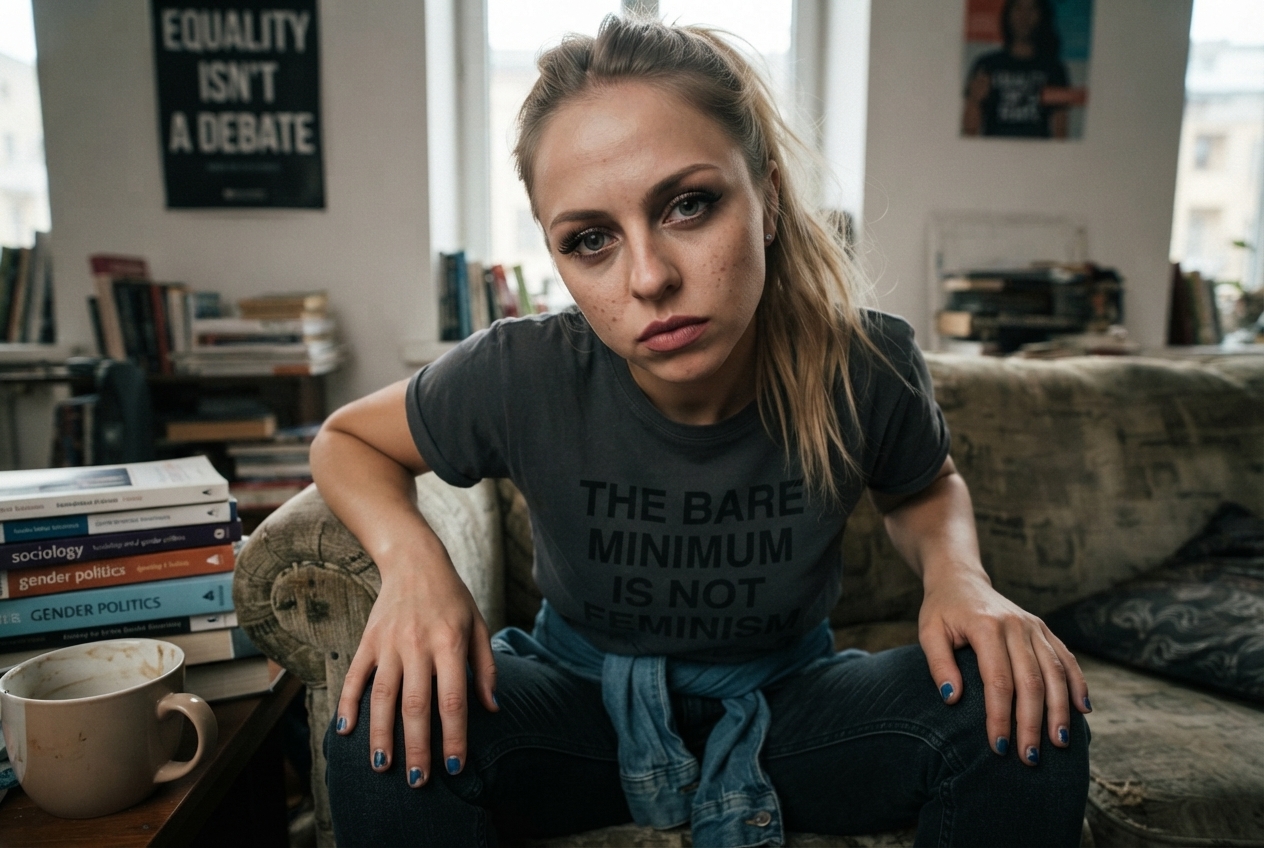
I was sat on my sofa last Tuesday with my third oat-milk flat white of the day, vape in one hand, phone in the other, when The Coven group chat exploded. One of the girls had just come back from a date. Proper nice bloke, she said. Held the door, asked about her job, even offered to split the bill without making a song and dance about it. Then over dessert he dropped the line that made her get up and leave before the tiramisu arrived.
“Feminism’s gone too far now, hasn’t it? Women have all the rights they need.”
She sent the voice note still shaking. Not angry-shaking. The quiet kind. The kind where you realise you have just wasted an evening on someone who thinks equality is a box you tick once and then put back on the shelf.
That chat stayed with me. I started asking around. Friends, mates from uni, women I met at the protest last month, even a couple of strangers in the Tesco queue who looked like they had stories. Fifty-nine percent of young women now treat feminism as a first-date filter. That number is not some abstract poll. It is the sound of women quietly deciding they would rather stay single than keep explaining basic decency to men who already think they have done enough.
I grew up in Basildon. Council estate, Sunday roasts at Mum’s, the usual Essex mix of loud opinions and even louder loyalty. I have always been the one who calls things out. But this feels different. It is not just me being “permanently outraged,” as some people like to put it. It is a generation of women who have watched the same pattern repeat and decided they are done paying the emotional bill.
The man who “does the dishes” is the one who keeps coming up. He will wipe the worktop. He will put the bins out. He will even remember your sister’s birthday. Then you mention that women still do three times the unpaid labour in the house and he looks at you like you have just accused him of war crimes. “I do my bit,” he says. And he does. His bit. The visible bit. The bit that gets praise.
What he does not do is notice that you are the one who remembered the bins needed doing in the first place. He does not clock that you are tracking the household stock, booking the dentist, remembering which friend is going through a rough patch. That mental load sits on your shoulders like a rucksack you never get to take off. When you point it out he gets defensive. Suddenly you are “keeping score.” Suddenly you are the problem.
I spoke to Priya, 27, who works in digital marketing in Shoreditch. She told me about the last three men she dated. All of them called themselves feminists. All of them posted the right infographics on International Women’s Day. One of them even had a tote bag that said “The Future is Female.” Then she asked him to look after her cat for a weekend while she visited her mum. He forgot to buy food. When she got back he said, “You should have written a list.” She laughed when she told me that part. The kind of laugh that has no humour in it.
“He thought feminism meant he could say the words,” she said. “He did not think it meant changing how he actually moves through the world.”
That is the gap. The words are cheap. The behaviour costs something. And a lot of men have decided the cost is too high.
Another woman, Leah from Leyton, put it more bluntly. She is 24 and works two jobs. She said she used to give men the benefit of the doubt. Now she asks three questions before she agrees to a second date. Does he think women should have the final say over their own bodies? Does he believe childcare is a team sport or a mother’s default setting? And the one that usually ends it: does he think feminism has “gone too far”?
The last one is the killer. Because the men who say yes almost never mean “I think we should stop at equal pay.” They mean they are tired of being asked to do the work. They mean they liked it better when women just got on with it and did not make them feel uncomfortable.
I have heard the pushback. “Not all men.” “You are being too picky.” “You will end up alone.” That last one is my favourite. It assumes being alone is the worst possible outcome. It assumes a mediocre relationship is better than your own company. I have tested that theory. My own company does not leave wet towels on the bed or expect me to manage its feelings after a long day. My own company does not need a round of applause for loading the dishwasher.
There is a safety piece in this too. Women are not just looking for someone who shares their politics. They are looking for someone who will not become a problem later. The man who thinks equality has gone too far is often the same man who gets quiet when you mention street harassment. He is the one who says “what was she wearing” before he has even heard the story. He is the one whose algorithm is already feeding him content that frames women as the enemy.
I asked a group of women in a Hackney café what they actually want. Not the Instagram version. The real version. They want a partner who does not treat their ambition like a threat. They want someone who can sit with the fact that they might earn more, or want different things from life, without making it about his ego. They want the mental load shared, not just acknowledged with a sad face emoji.
None of that is radical. It is basic. Yet it still feels like asking for the moon.
The women I spoke to are not anti-men. That is the bit people get wrong on purpose. They are anti the version of men who think feminism is a hobby they can pick up when it is convenient and drop when it asks something of them. They have watched their mothers and aunties do the double shift for decades. They have seen the burnout. They have decided they are not signing up for the same contract.
Some of them are still dating. They just do it with their eyes open. They leave earlier. They ask the awkward questions on date two instead of date twelve. They would rather have an empty Saturday night than another evening spent translating their own humanity.
I keep thinking about that girl in The Coven chat. The one who walked out before dessert. She said she felt guilty for a minute. Then she got home, put her pyjamas on, and realised the only thing she had lost was another evening of explaining herself.
That is the shift. Women are no longer treating single life as a waiting room. They are treating it as the default until someone proves they are worth the risk. And a lot of men have not noticed the rules changed.
The 59 percent figure is not a threat. It is a statement of terms. If you want in, you have to mean it. Not just on paper. Not just when it is easy. In the small, unglamorous moments when no one is watching.
I am not saying every woman has to stay single forever. I am saying the ones who do are not broken. They are choosing peace over another round of unpaid emotional labour. And after everything we have seen, that choice looks less like giving up and more like finally getting the point.
The men who get it will not need this article explained to them. The ones who do not will call it man-hating and go back to their For You page. That is fine. The rest of us will be over here, vaping, laughing in the group chat, and sleeping through the night without anyone asking us to manage their feelings first.
That is not loneliness. That is a boundary. And it is holding.