

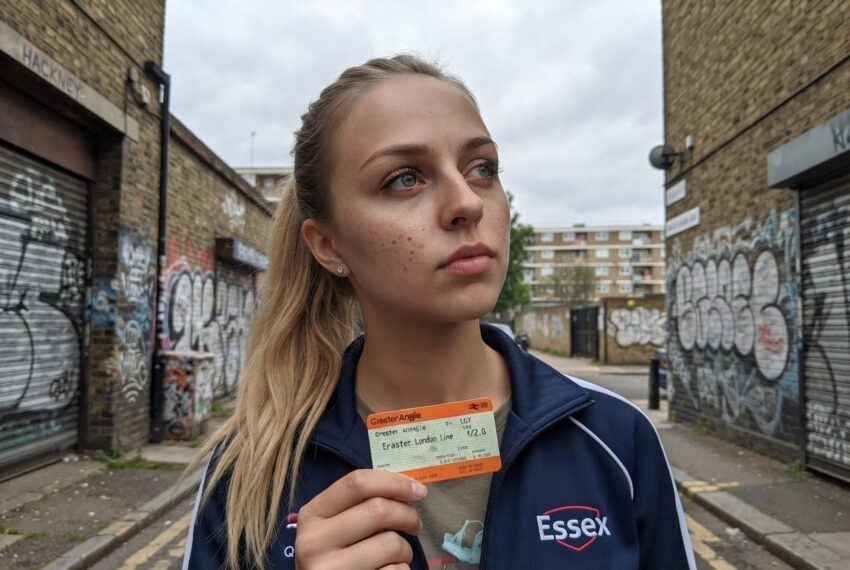
I’m on the floor again. Cross-legged on that cheap rug I bought from a market stall three years ago, laptop balanced on my knees, blue nails clicking against the keys. The oat-milk flat white has gone cold for the second time this morning. Outside the window Hackney is doing what Hackney does. Sirens, a fox screaming at something in the bins, two lads arguing about rent in voices that carry through the glass. It never stops. Even at half ten on a Saturday it feels like the whole borough is holding a meeting about the state of the world and nobody invited me but I’m expected to have an opinion anyway.
I grew up twenty-five miles away and it might as well be another country. Basildon doesn’t do this. Basildon does quiet Sundays and the sound of a kettle and my mum shouting up the stairs that dinner’s ready whether you’re hungry or not. I keep telling myself I chose this life. The city, the work, the late nights writing things that get shared before breakfast. But every other weekend I pack a bag and drive east and the second I hit the A13 something in my chest unclenches. Like I’ve been holding my breath the whole time I was here.
Hackney is full of people who talk about class like they invented it last Tuesday. They’ve read the books. They’ve been on the marches. They know the language. Working-class this, late-stage that. I sit in those rooms sometimes and I want to laugh because none of them have ever lived in a house where the heating went off at eight to save money. None of them know what it feels like when the whole street smells of chip fat on a Friday night and everybody’s out the front because the weather’s finally decent. They mean well. Most of them. But it’s theory to them. It’s the air I breathed for eighteen years.
I moved here when I was twenty-two. Thought I was escaping. Thought London would make me sharper, more serious, less Essex. I flattened my accent for the first six months. Practised in the mirror like an idiot. Then one day I was in a meeting and some bloke from north London started explaining poverty to me and I just let the Basildon come back out. Thick as you like. He looked at me like I’d sworn in church. I didn’t get the commission. Didn’t care. That was the first time I realised I wasn’t going to fit neatly anywhere.
Back home they think I’ve gone posh. My cousin still calls me “London Emma” when he’s had a few. Like I’ve forgotten where the Tesco is. I haven’t. I still know which aisle the cheap wine lives in. I still get the meal deal on the way back from Mum’s even though I’ve got a fridge full of stuff I bought in a shop that sells oat milk in three different brands. The two versions of me don’t talk to each other much. The Hackney one writes threads about systemic this and that. The Basildon one just wants to sit at the table and listen to my mum go on about the neighbours and whether the new people at number fourteen are all right.
Sunday roast is the thing that keeps me honest. Every other week I walk through that front door and the smell hits me before I’ve even taken my coat off. Beef or chicken, Yorkshire puddings that could double as boats, gravy that could start a fight if you criticised it. Mum still uses the same old plates. The ones with the little chips on the edges. She asks if I’m eating properly before I’ve sat down. I lie and say yes. Then I eat enough for three people because that’s what you do. You don’t leave food. Not in that house. Not after the years we had when money was tight and leftovers were the next day’s dinner.
The drive home is always the same. I put the radio on something mindless and watch the landscape change. Flats give way to houses. Houses give way to the big roundabouts and the retail parks. By the time I park outside Mum’s the city version of me has gone quiet. I sit in the car for a minute sometimes. Vape out the window. Cherry cloud drifting. Then I go in and I’m twelve again, being told to take my shoes off and wash my hands. It’s embarrassing how much I need it.
People in Hackney ask why I still bother. “You live here now,” they say, like geography is a personality. They don’t get that home isn’t a postcode. Home is the net curtains my mum refuses to take down because “they’re perfectly good.” Home is the way my dad still reads the paper at the table and pretends he’s not listening when the conversation turns to politics. Home is knowing that if everything went to shit I could turn up with a bag and they’d make up the spare room without asking too many questions.
I try to explain it and it comes out wrong. Sounds like I’m romanticising poverty or something. I’m not. The estate wasn’t magic. It was damp in winter and the lifts broke and everybody knew everybody’s business whether you wanted them to or not. But it was ours. You looked after your own. You didn’t need a think-piece to tell you that. You just did it. Now I live in a place where looking after your own gets called community organising and comes with a WhatsApp group and a Google Doc.
The Coven group chat lights up at all hours. Leaks, gossip, someone having a go at a minister, someone else having a go at the first person for the way they phrased it. I love them. They’re the closest thing I’ve got to a work family. But none of them grew up where I did. When I tell stories from home they listen like I’m describing a documentary. Interested. A bit distant. Like I’m the expert on a place they’ve only driven through.
I catch myself doing the opposite when I’m back in Basildon. Talking too fast. Using words I picked up in London. My aunt once told me I sounded like I was on the telly. She didn’t mean it as a compliment. I spent the rest of the afternoon trying to sound more like myself and failing. You can’t win. Too much of one place and the other one notices.
Nights are the worst for it. In Hackney I lie in bed and hear the city going on without me. In Basildon the quiet feels heavier. Like the whole town has agreed to go to sleep at a reasonable hour and I’m the only one still awake thinking about deadlines. I used to think I’d get used to one or the other. I haven’t. I just got better at pretending.
There’s a particular kind of tired that comes from living in two places at once. Not the good tired from a long walk or a proper night out. The other kind. The one where your brain is still half in the last conversation you had at Mum’s table while your fingers are typing a thread about something that happened in Westminster. I drink too much coffee to keep both versions running. I vape too much because it gives my hands something to do when the two worlds start arguing in my head.
I used to think I had to pick. Stay in London and become the person who writes the pieces and never goes home except for Christmas. Or move back and become the person who talks about “when I lived in London” like it was a phase. Neither option felt right. So I keep doing this. Fortnightly pilgrimage. Bag in the boot. Same playlist. Same service station coffee that tastes like regret. Same feeling when I pull up outside the house and see the light on in the kitchen.
Last time I was there my mum asked if I was happy. Just like that, over the washing up. No warning. I said the usual. Work’s good. Flat’s fine. Friends are sound. She looked at me the way only mothers can and I knew she didn’t believe a word. She didn’t push it. Just handed me a tea towel and told me to make myself useful. That’s the thing about home. It doesn’t need the speech. It already knows.
I don’t know if I’ll ever feel completely settled. Maybe that’s the point. Maybe some of us are meant to live in the gap. Close enough to both that we can see the best and the worst of each. Close enough to miss one when we’re in the other. I used to fight it. Tried to be more Hackney. Tried to be more Basildon. Now I just let it be what it is. A girl from an estate who ended up in a city that talks a lot and a hometown that doesn’t need to.
The flat white is stone cold now. I should make another one. Or I should pack the bag for tomorrow. I haven’t decided which version of me is winning today. Probably neither. That’s all right. I’ve got used to the draw.